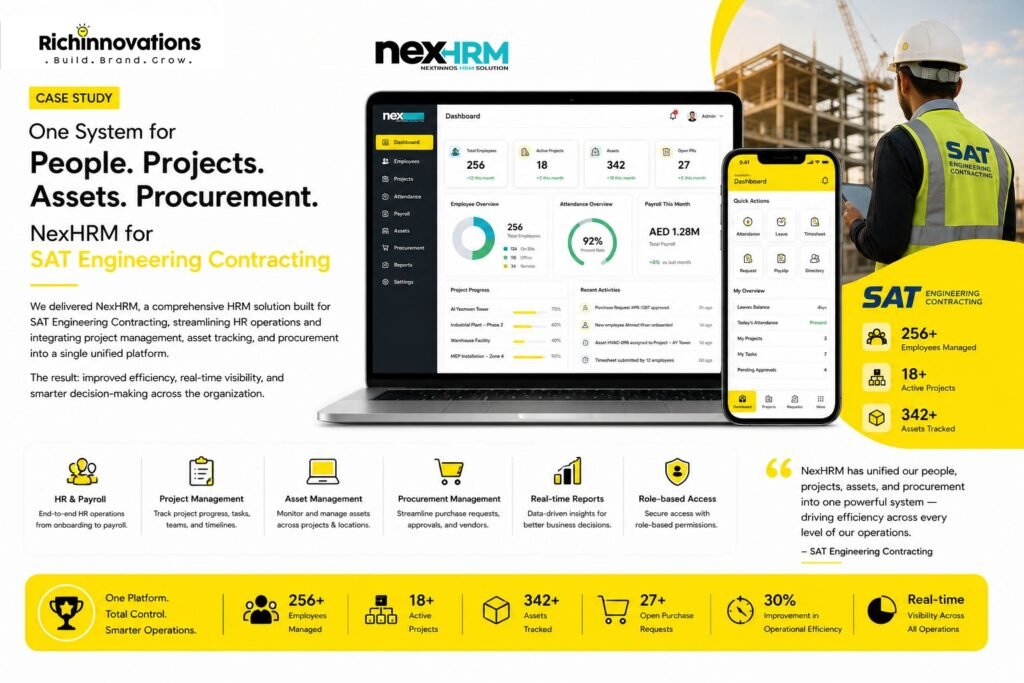
1. We extended the product instead of forcing a fit. Rather than asking the client to adapt their operation to standard HR software, we customised NexHRM with four purpose-built modules — Procurement, Accounts Payables & Receivables, Project Management and Asset Management — running on the same platform, the same login and the same underlying data. One system, one source of truth, no reconciliation between tools.
2. We built site-aware attendance controls. Shift configuration covers designated clock-in time, the earliest permitted clock-in, the latest permitted clock-out, and the threshold after which an employee is marked late. Self-clocking can be enabled or disabled per shift, and clock-in and clock-out are restricted to authorised IP addresses, with the originating IP recorded against every attendance entry. Attendance details and monthly summaries make marked and unmarked days visible at a glance.
3. We built asset management around movement, not storage. Assets are classified by category and captured with asset code, model number, quantity, purchase date and unit price. Allocation records the project, the location, the assigned employee, the quantity issued and the expected return date. Returns are logged with remarks and supporting document upload, and maintenance activity is recorded against each asset and flagged as either an expense or a note — giving the client a complete lifecycle record from acquisition through allocation, return and upkeep.
4. We connected procurement end to end. Products are organised by category and subcategory and flagged as asset or non-asset items. Suppliers carry opening balances, contact details and tax information. Purchase orders capture supplier, product, quantity and expected delivery date; purchases then import those orders, allow quantity adjustment where reality differs, record payment and payment mode, and flag credit transactions — with entries flowing automatically into both inventory and the supplier’s account. Product-wise, supplier-wise, purchase and credit payment reports close the loop.
5. We made the financial position visible. Credit payments arising from purchases reflect automatically into payables, removing the manual step where liabilities were previously lost. Payables capture cheque number and cheque date; receivables are recorded against users with date, amount and remarks. Reporting covers payables, receivables, date-range views and ageing analysis, so the client’s position is a report rather than an exercise.
6. We gave projects a proper record. Projects are registered with description, location, start date and tentative end date. Allocation assigns a project manager and multiple employees through dropdown selection, and supports multiple locations per project — reflecting how contracting work actually runs. Administrators move projects from Ongoing to Completed, keeping status current across the organisation.
7. We automated employment documentation. A letterhead template engine lets the client build reusable, styled letter formats through a built-in editor, then generate official documents for a selected employee with preview before finalising. Warnings, resignations, terminations and complaints each capture their required detail and attach to the appropriate template — so formal correspondence is consistent, on-brand and produced in seconds.
8. We handled payroll’s real complexity. Salary groups and annual CTC drive calculation. Pre-payments record advances lent to employees. Increment and promotion actions track salary changes and designation moves, filterable by action type. Employee expense claims can be settled immediately from a selected account or marked for deduction when the month’s payroll is processed — so claims reconcile automatically instead of being remembered.
9. We enforced structure through permissions. Every employee carries a location, shift, department, designation and a report-to relationship defining who they answer to. Manager roles and module-level visibility control what each user can see and do, so payroll, disciplinary records, supplier pricing and financial reporting stay with the people entitled to them.
10. We added the operational layer around the core. Beyond the headline modules, the deployment covers leave types with entitlement tracking, remaining and unpaid leave visibility, holiday and weekend configuration, an awards and appreciations framework with monetary values drawn from a nominated account, company policies applied by location, internal news with targeted visibility, and survey forms with configurable questions and review indicators for structured employee feedback.