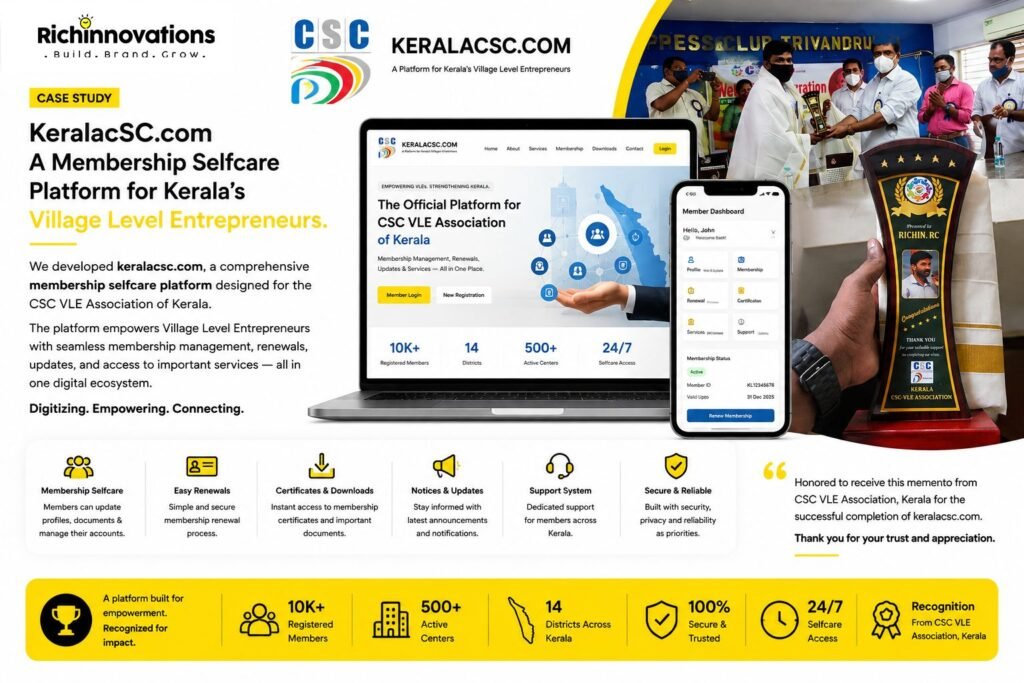
1. We put the entire membership lifecycle online. Registration, membership fee payment, subscription renewal and portal access were built as a connected flow on the website. A VLE in any district can join, pay and maintain their membership without travelling to the association’s office — which is what makes a genuinely state-wide membership organisation practical.
2. We built eligibility into the registration process. The application captures CSC ID and centre details as part of registration, giving the association what it needs to verify a valid CSC ID and apply its exclusion rules before granting membership. Approval remains with the Executive Committee, with the platform supplying verified information rather than bypassing governance.
3. We connected registration to payment explicitly. After submitting their application, members are taken to a confirmation step that directs them to complete the membership fee payment, with instructions to enter their CSC ID and centre name in the payment remarks. That single instruction is what allows the association to reconcile an incoming payment against the correct application — a small design decision that prevents a large administrative problem.
4. We supported the payment methods the membership actually uses. Membership fees can be paid by bank transfer, Google Pay, or through the payment gateway integrated into the association’s website. Rather than forcing one method, the platform accommodates how small rural entrepreneurs prefer to pay.
5. We built subscription renewal as a self-service function. A dedicated renewal facility lets members extend their subscription directly, keeping their portal access continuous. Because renewal is tied to the same account and payment flow as registration, the association maintains a coherent record of each member’s subscription period rather than a spreadsheet of manual entries.
6. We implemented access control tied to membership status. The member portal sits behind login, with registration and access governed by membership standing. That gives the association the enforcement mechanism its byelaws require — member-only areas genuinely remain member-only, and lapsed access follows the rules rather than depending on someone remembering to act.
7. We delivered a separate society mapping portal with controlled credentials. The CSC VLE Mapping Society Portal operates as a distinct, credential-controlled area, with access issued by the administrator rather than through open registration. Sensitive internal functions are separated from general membership features rather than sharing the same door.
8. We gave the association full editorial control. Announcements, membership campaigns, notices, contact information and informational content are managed by the association directly through the CMS. When a recruitment campaign runs with specific dates and terms, the association publishes it themselves, immediately.
9. We structured public information around the CSC mission. The site explains what Common Services Centres are, their role in Digital India, and the association’s mission of supporting VLEs through training and projects — with links to the official MeitY, MyGov, VLE Registration and CSC Digital Seva resources. Prospective members and the wider public find the context they need without navigating into member-only areas.
10. We published the governance framework properly. Terms and conditions derived directly from the association’s byelaws set out eligibility, membership start and duration, fee payment methods, Executive Committee approval, renewal consequences and termination conditions. Registered office address, email and phone contacts are published clearly. For an organisation collecting fees from its own members, that transparency is a functional requirement rather than a formality.