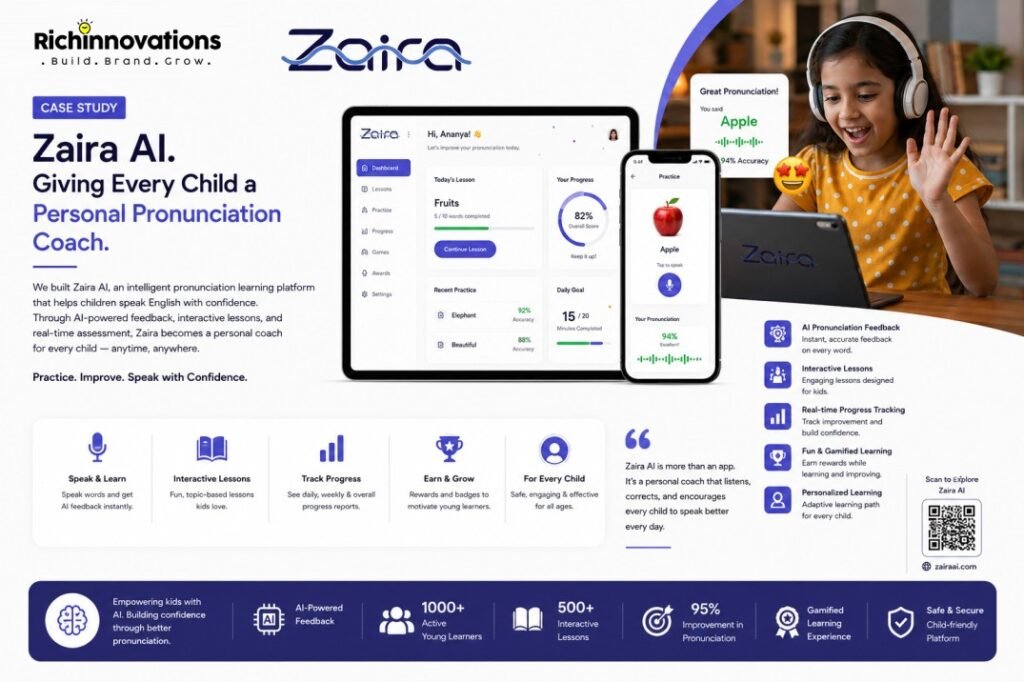
1. We gave every child their own AI listener. The core of the platform evaluates a child’s spoken reading and returns immediate feedback on their pronunciation. Thirty children can each receive individual attention in the same lesson — which is the single thing a human teacher, however skilled, cannot provide at that scale.
2. We built the loop around retry, not judgement. The child speaks, hears how they did, and tries again straight away. Because the AI is endlessly patient and entirely private to that child, learners attempt words they would never risk saying aloud in front of classmates. Removing the audience removes the fear that suppresses practice.
3. We designed an interface a pre-reader can operate independently. Navigation, prompts and feedback are carried visually and through audio rather than text, so a kindergarten child can use the platform without an adult reading the screen to them — while the experience scales in complexity for older primary students.
4. We tuned the system for children’s voices and age-appropriate expectations. Assessment accounts for the characteristics of young speech and for what is reasonable to expect at each stage from KG to Grade 6, so feedback reflects genuine pronunciation issues rather than penalising normal developmental variation.
5. We built feedback to encourage rather than correct. Responses are framed to keep young learners trying. Confidence is the limiting factor in early speaking practice, and a system that makes a child feel wrong is a system they stop opening.
6. We built a dedicated teacher portal. Teachers assign practice, monitor progress across their class, and see at a glance which students are on track and which need direct attention. The platform surfaces what the teacher needs to act on rather than a raw data dump — turning the AI’s assessment into a targeting tool for the teacher’s limited one-to-one time.
7. We built a school administration portal. School administrators manage teachers, classes and student enrolment, with visibility across the school rather than a single classroom. Onboarding, structure and oversight sit with the school, so the platform runs as institutional infrastructure rather than a collection of individual accounts.
8. We gave parents visibility and control. Parents can follow their child’s progress and manage their access, connecting home and school around the same record. A child practises at home on mobile, and the teacher sees that practice reflected in class the next day.
9. We replaced impressions with measurable progress. Every practice session produces data, so improvement over weeks and terms becomes something a teacher can demonstrate to a parent and a school can evaluate across cohorts — rather than something everyone senses but nobody can evidence.
10. We delivered web and mobile so practice follows the child. The platform runs on the web for classroom and shared-device use and on mobile apps for practice at home. The same account, the same progress, both settings.
11. We built with children’s data protection as a design constraint. Role-based access ensures teachers see their own classes, administrators see their own school, and parents see only their own child. Access boundaries are enforced by the system rather than trusted to convention.