1. We brokered the connection instead of revealing it. The platform sits between the two parties and passes the alert through. The person who is blocked never receives the owner’s number, and the owner never receives the sender’s. The connection happens without either identity being disclosed — which is the single design decision the entire product rests on.
2. We made privacy a set of user choices, not a fixed setting. Users can hide their name, hide their contact number, or use the app entirely anonymously while retaining full functionality. Rather than imposing one privacy posture, the product lets each person decide how visible they want to be — and the most protective option remains fully usable.
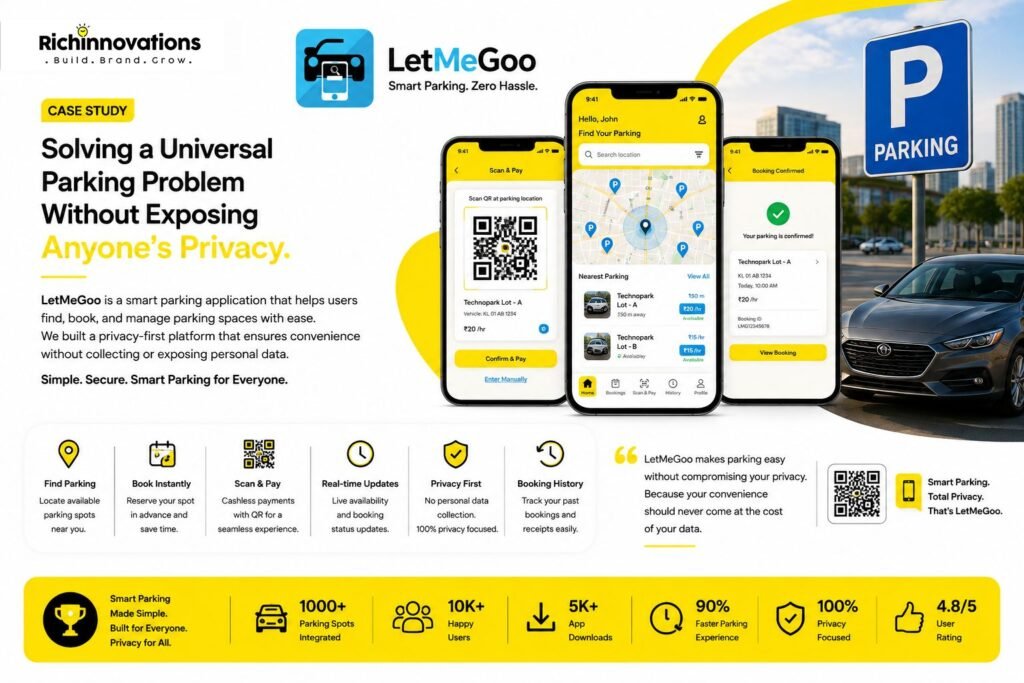
3. We reduced the interaction to three steps. Enter or scan the vehicle number, send the alert, get moving. Scanning removes typing errors and one-handed fumbling at the moment of need, and photo alerts let the sender show the situation rather than describe it. The entire flow is built for someone standing beside a car in a hurry.
4. We removed confrontation from the equation. Because the alert is delivered by the platform rather than face to face, nobody has to knock on a window or approach a stranger. The owner receives a factual notification about their vehicle and responds to it. Removing the human confrontation removes the escalation risk that makes people avoid dealing with the problem at all.
5. We treated abuse prevention as core product design, not an afterthought. A published Fair Usage Policy defines prohibited conduct explicitly — abusive, obscene or offensive messages and images, content that violates another user’s dignity, and any use of the app for harassment, bullying, stalking or defamation. Violations carry defined consequences: immediate account suspension, permanent deactivation, and referral to law enforcement or the Motor Vehicle Department, Kerala where circumstances warrant it. The rules exist, they are public, and they are enforced.
6. We built reporting directly into the app. Any user receiving an inappropriate message or image can report it from within the app. Enforcement does not depend on victims finding a support email — the escalation path sits inside the moment the problem occurs.
7. We made data minimisation a hard rule. Reported messages and images are retained for a maximum of two days, purely to allow investigation, and are then automatically and permanently erased from our servers and our backups. Users can permanently delete their account at any time, with associated data removed from active systems and backups. The product holds sensitive data for as short a time as its function allows, by design rather than by policy statement alone.
8. We defined a lawful, bounded channel to authorities. Where an official request is made, LetMeGoo may share user reports or images with the Motor Vehicle Department, Kerala Government or other authorised government bodies — but only upon lawful demand and in compliance with applicable data protection law. The boundary is explicit in both directions: users know cooperation exists, and they know it is not open-ended.
9. We removed every barrier to adoption. The app is free. Given that the product’s usefulness grows with the number of drivers on it, charging at the point of entry would have worked directly against the thing that makes it valuable. Growth was prioritised over monetisation at launch, deliberately.
10. We built the product around behaviour change, not just notification. LetMeGoo is positioned to improve parking culture, not to police it. Alerts are framed as helpful prompts rather than accusations, and the Hall of Fame collects real user stories and video demonstrations of the app resolving situations — turning early adopters into advocates and giving prospective users something concrete to judge before they download. An active social presence across Instagram, X and Facebook supports the same community-building objective.
11. We anchored it in a clear legal framework. The Fair Usage Policy operates alongside published Terms & Conditions and a Privacy Policy, governed by the laws of India with jurisdiction in Thiruvananthapuram, Kerala. For a product handling this category of data, a visible and coherent legal foundation is part of the offering rather than paperwork behind it.