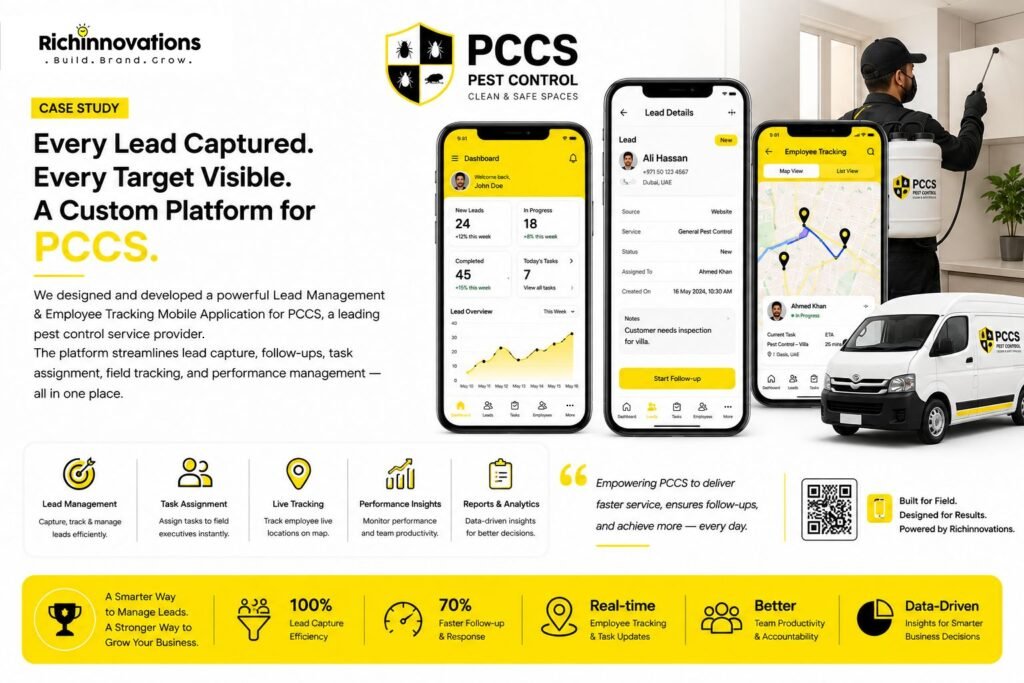
1. We built for the field first, then the office. The platform was delivered as two connected applications: a web application for management, administration and back-office work, and an Android application for employees in the field. Field staff record activity where it happens, on the device already in their pocket, and it appears immediately in the office system. Adoption was designed for rather than hoped for.
2. We made lead capture immediate and low-friction. Leads can be added from either the web application or the mobile app, with data auto-pick reducing the amount of typing required on a phone. Because entry takes moments and happens on the spot, the enquiry reaches the system while the detail is still fresh — instead of being reconstructed from memory at the end of the week.
3. We removed attribution disputes entirely. The responsible employee is selected automatically based on the logged-in user. Whoever records a lead is attributed to it, without manual assignment and without argument. Credit and accountability are established at the moment of entry.
4. We gave every employee a target and made progress visible. Target counts are set per employee within the employee management module, and employee reporting measures actual performance against them. Management can see who is ahead and who needs support while the month is still running, and staff can see exactly where they stand.
5. We built a lead pipeline with memory. Every lead carries a status that moves as it progresses, plus a remark log recording each interaction. Anyone picking up a follow-up sees the full conversation history first — what was discussed, what was quoted, what was promised — so the customer experiences continuity rather than repetition.
6. We modelled the service catalogue the way the business sells. Services are defined centrally with pricing and service frequency, and configured as single jobs, AMC contracts or long-term arrangements. Adding, editing or removing services is an administrative action rather than a development request, so the catalogue keeps pace with the business.
7. We structured service delivery and assignment. Service entry links a customer to a service, the employee delivering it and the BDO who owns the relationship. Reporting is available user-wise, type-wise and by date range — making it straightforward to see which services are selling, who is delivering them, and how performance moves over a chosen period.
8. We solved attendance for a workforce that is never in one place. Employees mark punch-in and punch-out through the web application, and through the mobile app with geo-tagging so attendance is recorded with location. The app also raises an alert if a device goes offline for more than three minutes during working hours, giving supervisors a reliable picture of field activity through the day rather than only at its start and end.
9. We built proper sales and collection tracking. Sales entry links a customer to a bill and supports part-by-part payment, with a customer ledger maintaining the running position for every account. Outstanding balances are visible at a glance instead of being calculated on request.
10. We brought expenses into the same system. Expenses are recorded against individual users and categorised, with support for both one-off payments and recurring payments configured by interval. Expense reporting sits alongside sales and lead reporting, so cost is visible in the same place as revenue.
11. We gave management a single dashboard. The admin dashboard consolidates lead reporting, sales view, expense view and employee reports into one place. The complete operating picture — enquiries generated, services delivered, revenue collected, costs incurred and individual performance — is available on demand rather than assembled monthly.
12. We separated access by role. The platform operates across three levels: super admin, sub admin and employee, with the ability to grant or revoke access per user. Sensitive commercial and performance data stays with the people entitled to see it, while field staff get a focused interface containing only what they need to do their job.
13. We built with branch expansion in mind. The architecture supports multi-branch operation, with a branch admin able to see only their own branch’s data and the super admin retaining a consolidated view across all branches — so growth into additional locations is a configuration step rather than a rebuild.