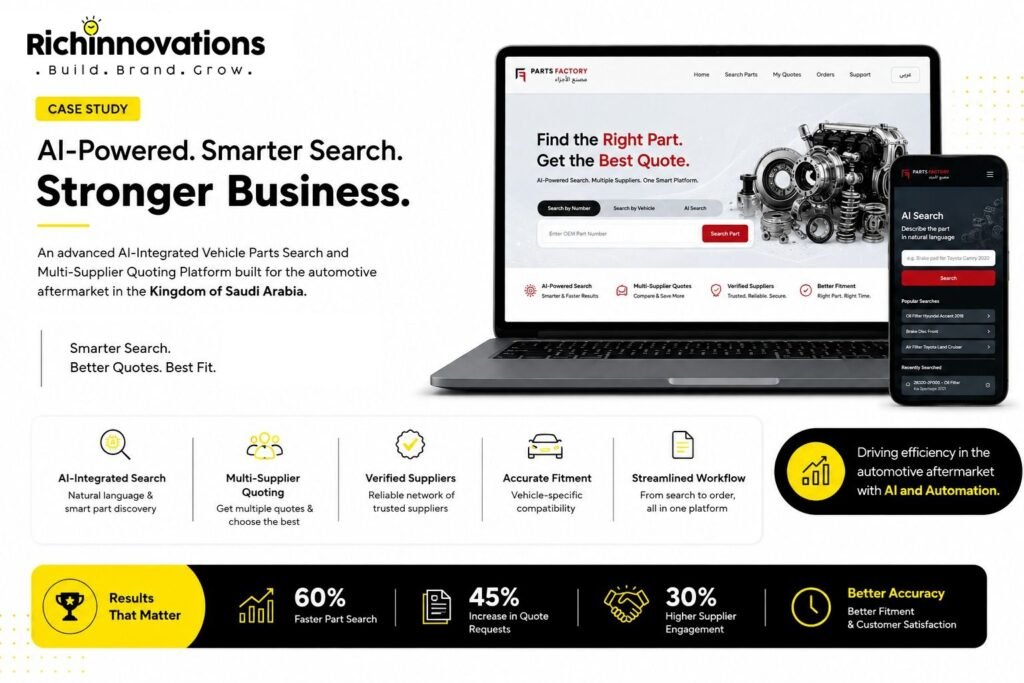
1. Multi-modal AI part identification. A dedicated Search Coordinator service accepting text, images, audio, OCR-scanned documents and VIN input, returning ranked part candidates with a confidence score against each. Buyers search with whatever evidence they actually have, not the reference number they don’t.
2. Confidence thresholds and structured clarification. Business thresholds are enforced by the platform rather than the model. Above the threshold a part is auto-confirmed; below it, the system identifies exactly which fields are missing, generates targeted clarification questions, and re-invokes identification with enriched session context. Thresholds are client-configurable without code changes.
3. Automatic demand aggregation. Customer requests are split into line-level demand and aggregated into Demand Buckets — grouped by product and by the constraints that genuinely matter: brand requirement, condition, destination, urgency, pack size and whether alternatives are accepted. Admins source one bucket once, on behalf of every customer behind it.
4. The frozen batch rule. Once a Supplier RFQ Batch is sent it cannot be altered by new demand, which flows into the next batch automatically. Amendments before supplier response are permission-controlled, written to the audit trail and trigger supplier notification. Every supplier quote is a response to a fixed, known question.
5. Mixed-source procurement with blended costing. Native support for split sourcing — 60 units from one supplier, 25 from another, 15 from a third — with a weighted blended landed cost calculated across the selection, inclusive of freight, duties, taxes and handling, before the margin rule is applied.
6. Controlled costing and pricing gates. Margin below threshold requires an approver. Every manual price override requires a written reason before it can be saved. Supplier validity dates automatically cap customer quote validity, and MOQ or pack-size conflicts raise warnings before a selection can be confirmed.
7. End-to-end traceability. A four-layer chain built into the data model — Customer RFQ Line → Demand Bucket → Supplier RFQ Batch → Supplier Response → Costing → Allocation → Quote Package → Order — traceable in both directions on every line, with full internal source lineage visible to admins.
8. Backend-enforced role visibility. Permissions are enforced at the API layer, not hidden in the frontend. Buyers never see supplier names, supplier costs, landed cost, margin or source mix. Suppliers never see customer identity, final selling price, allocation or competing responses. Seven roles carry granular per-action permissions, covered by explicit acceptance tests.
9. Rule-based allocation with guardrails. An allocation workspace distributing available supply by urgency, account priority and submission order, with manual override. Over-allocation is blocked at system level, and lines flagged “full quantity required” cannot be partially quoted without customer consent. Pending and held lines stay visible but are excluded from the payable total.
10. Full versioning of responses and quotes. A revised supplier response creates a new version and preserves the prior submission with its reason for change. The same applies to quote packages, so the client can prove exactly what was offered, by whom, and when.